Purbeck Saxon Longship Project
SÆXIA is revisiting ambitious plans for a project first publicised in 2023: to explore the design and eventual construction of a full-sized Anglo-Saxon fighting ship associated with the age of King Alfred the Great.
The original proposal attracted considerable local interest and SÆXIA is maintaining the research and grounding phase primarily as a historical and experimental-archaeology project, aimed at eventually answering a pertinent question which remains surprisingly unfamiliar to the wider historical community :
What did an Anglo-Saxon warship actually look like?
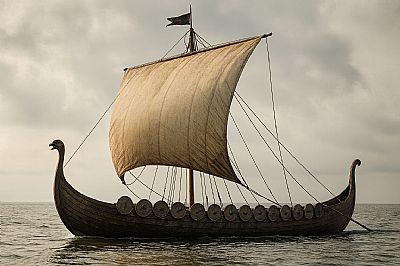
Before the “Viking longship”...
The image of the Viking longship has become one of the most recognisable symbols of the Early Medieval world. Long, narrow clinker-built vessels filled with warriors, oars and shields have become firmly established in popular culture.
Yet the maritime tradition from which such vessels developed was not exclusively Scandinavian, nor did it suddenly appear with the beginning of the Viking Age.
The Anglo-Saxons themselves had crossed the North Sea in ships centuries before the famous Scandinavian raids of the late eighth and ninth centuries. Maritime travel, warfare and migration were fundamental to the Germanic cultures surrounding the North Sea.
The extraordinary seventh-century ship burial at Sutton Hoo provides perhaps the most famous archaeological evidence from Anglo-Saxon England. Although the original timbers had largely disappeared, the impression of the vessel preserved in the earth revealed a substantial clinker-built ship approximately 27 metres long.
Today, the Sutton Hoo Ship's Company is undertaking the remarkable task of constructing a full-sized reconstruction of that vessel, bringing considerably greater public attention to the reality of large Anglo-Saxon ships.
But Sutton Hoo represents a vessel from the seventh century.
SÆXIA's particular interest lies somewhat later — in the ships of Alfred the Great and the wars of the ninth century.
Alfred's mysterious ships
One of the most intriguing descriptions of Anglo-Saxon naval development occurs in the Anglo-Saxon Chronicle during the reign of Alfred.
In its account for AD 896, the Chronicle describes ships ordered to be built by Alfred to oppose Danish raiding vessels.
Remarkably, the chronicler specifically tells us that these new ships were neither of the Frisian design nor of the Danish design, but were built according to Alfred's own conception.
They are described as being considerably larger than the vessels they were intended to oppose, with more oars, and as being both faster and steadier.
That tantalising description leaves an extraordinary unanswered question.
What were they?
No securely identified archaeological wreck of one of Alfred's purpose-built warships survives from which a replica can simply be copied.
Consequently, attempting to reconstruct one becomes an exercise in experimental archaeology rather than straightforward reproduction.
The archaeological evidence for contemporary North Sea shipbuilding can be combined with the documentary evidence, known Anglo-Saxon woodworking and shipbuilding techniques, hydrodynamics and practical experimentation.
Rather than claiming to have discovered exactly what Alfred's ships looked like, the objective would be to produce a credible working hypothesis — and then put that hypothesis to the test.
Why build one?
A reconstruction becomes much more than a museum object when it is placed in the water.
How quickly can it accelerate under oars?
How effectively can it turn?
How does additional freeboard affect stability and fighting ability?
How does it behave under sail?
How many people are required to operate it effectively?
And, most importantly, how might its performance compare with contemporary Scandinavian-style vessels?
These are questions which cannot be answered completely by looking at illustrations or archaeological plans.
Experimental archaeology allows a reconstruction to become, in effect, an experiment.
If a vessel built according to a particular interpretation performs badly, that result is itself useful evidence. If it performs remarkably well, we learn something else.
Why Purbeck?
For SÆXIA, there is also a powerful local connection.
Purbeck and the waters surrounding Swanage and Wareham were not distant from the conflicts of Alfred's age.
The Anglo-Saxon Chronicle records Scandinavian forces operating in Dorset and specifically around Wareham during the dramatic events preceding Alfred's victory over Guthrum.
The coastline, harbour and waterways of Purbeck therefore provide an unusually appropriate landscape in which to interpret the maritime dimension of the period.
A reconstructed Anglo-Saxon fighting ship operating in these waters would connect archaeology, local history and experimental research in a very tangible way.
It would also help challenge one of the most persistent misconceptions surrounding the Early Medieval period.
The long, clinker-built fighting ship was not simply a “Viking longship.”
The peoples whom we now call Anglo-Saxons were themselves part of a much older North Sea maritime world.
They crossed seas, traded by sea and fought at sea.
By Alfred's reign, England was confronting Scandinavian fleets with ships of its own — including vessels sufficiently unusual for a contemporary chronicler to remark that they followed neither the established Danish nor Frisian model.
A long-term SÆXIA project
SÆXIA therefore continues to regard the Anglo-Saxon ship project as a worthwhile long-term ambition.
The emphasis today is not upon launching another large public fundraising campaign, but upon developing the historical research, exploring potential designs and construction methods, building relationships with people possessing relevant maritime and archaeological expertise, and considering how such an ambitious experiment might realistically be undertaken.
The success of the modern Sutton Hoo reconstruction has already demonstrated just how powerful experimental shipbuilding can be in reconnecting people with Anglo-Saxon England.
SÆXIA's proposed vessel would ask a different question.
Rather than reconstructing the magnificent seventh-century ship buried at Sutton Hoo, it would attempt to investigate the largely forgotten Anglo-Saxon fighting ships of the Viking Age itself.
The Vikings have had their longships in popular imagination for a very long time.
Perhaps it is time to remember that the Saxons had ships too.